


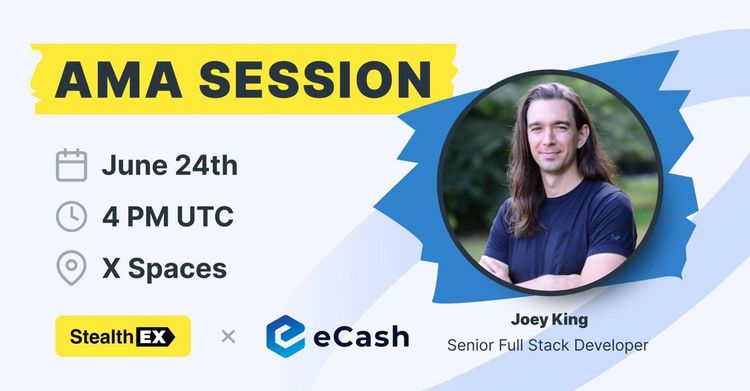
StealthEX instant crypto exchange recently hosted an X Spaces AMA with Joey King, Senior Developer at eCash, to discuss the evolution of peer-to-peer electronic cash, tokenization, privacy, artificial intelligence, development tools, mining, and the future of the eCash ecosystem.
1. With easy token minting and integrated DEXs and wallets, what traction have tokens seen? Plans for standards, bridging, or features that could drive DeFi-like activity without compromising the cash focus?
Joey: Tokens have dominated the crypto landscape since around 2018. That said, we have not seen many tokens do much beyond solving the problem of raising money.
There have been all kinds of narratives around different projects, but most of the successful and memorable tokens people think about today were primarily issued to raise capital—and they succeeded at doing that.
Projects such as Pump.fun eventually removed the pretense that a token needed to have a narrative or utility. The entire purpose became trying to make the price of a token go up.
That was the initial phase of tokens in cryptocurrency. It was dominated by account-based chains such as Ethereum and Solana because those chains offered richer features for automated market maker and decentralized exchange trading.
However, tokens and NFTs originally got their start on UTXO chains, including Bitcoin and later Bitcoin Cash, and they continue to exist on eCash.
Token protocols on UTXO chains have several advantages. This is one of the reasons Tether was initially so successful on Bitcoin and why some other token projects were able to get off the ground quickly.
You have instant transactions, and simple token operations such as minting, burning, and sending are easy to perform.
What is more complicated on a UTXO chain is the fundraising side: setting up an AMM, establishing a market price for a token, and trying to generate speculative interest. Those activities became especially popular on Ethereum and Solana.
eCash introduced a solution to this approximately a year ago through the Agora decentralized marketplace. Agora makes it possible to assign a price to specific UTXOs, allowing anyone to list any quantity of any token at any price.
We have seen meaningful traction. The marketplace is approaching approximately USD 5 million in volume. That may not be as large as platforms such as Pump.fun, but eCash trading volume has largely been driven by utility-based projects rather than purely speculative tokens.
One example is the Firma Alpha stablecoin, which includes native yield. Its value is designed to remain around USD 1, so it is not something people expect to pump. Nevertheless, it has represented approximately 10% to 15% of marketplace trading volume.
There is also Staked XEC, a staking token that allows users to earn crypto yield without having to operate a node. Its price is pegged to XEC.
Neither of these is a speculative token designed around price appreciation. They are utility tokens, and tokens like these have dominated trading volume on the Agora marketplace.
Growth has been steady. We are still at a very early point on an exponential curve, but the growth has been organic rather than top-down.
We have not followed the model where a market becomes hot, everyone issues a token, and participants try to find the one token that will pump. That kind of memecoin-driven financialization has not happened to the same extent on eCash.
On one hand, this means the volume may appear lower. On the other hand, the volume comes from real projects, and the growth is organic and incremental. I believe that is a more sustainable way to ensure that you are building something that solves an actual problem.
Monetary problems are also political problems. There is no benefit in simply lamenting human nature. The best systems accept human behavior as it is and create incentives that improve outcomes.
Monetary systems must do the same. We are trying to facilitate trade between people. We cannot design a system around the assumption that people will suddenly behave differently. The goal is to create the right tools and incentives to channel behavior in a direction that benefits everyone.
2. Why did eCash choose a total supply of 21 trillion, with two decimal places instead of retaining Bitcoin’s 21 million coin format? What are the psychological or practical advantages of this approach in making everyday purchases in stores?
Joey: The best way to understand this is to look at the debate Bitcoin has been having for the past decade.
Bitcoin users have gone through internal disagreements over whether people should use bitcoins, satoshis, bits, or millibits, as well as broader debates around unit bias.
Fundamentally, people do not naturally think in long strings of decimal places. Outside scientific and mathematical applications, that is not how people normally represent units, particularly when making everyday currency transactions.
This was not really a decision to change the supply. Bitcoin already had a reasonable supply that had been issued through a transparent system. There was no need to fix something that was not broken.
eCash simply changed the denomination to two decimal places because that is closer to how people ordinarily think about money.
It can be difficult to explain that the underlying supply is effectively the same, but when someone uses an eCash wallet, the transactions are much easier to read and understand. The same applies when operating a node or viewing staking and mining rewards.
It makes considerably more sense than repeatedly seeing long strings of decimal places.
At the same time, crypto has not yet solved the challenge of unit familiarity. People still think in their local currencies and compare the value of crypto transactions with dollars, euros, or other familiar units. You cannot change that behavior through a top-down decision.
Decentralized crypto will probably gain broader adoption by first facilitating better local-currency transactions. Token protocols and stablecoins will be an important part of that process.
Once crypto becomes more useful and less volatile, people may gradually begin treating a crypto unit as a default standard.
The world’s reserve currency has changed multiple times throughout history and will change again in the future. For the foreseeable future, however, the US dollar will remain the standard people use. Facilitating those familiar types of transactions will therefore be one of the highest-leverage opportunities for successful crypto projects.
3. Tools such as PayButton make it much easier for online merchants to accept payments. However, does eCash have any plans to partner with physical point-of-sale providers so that eCash can be used directly at checkout counters in traditional retail stores?
Joey: There is no reason not to pursue that, but it must happen organically and incrementally.
A lot of effort in crypto has been directed toward making merchant adoption happen from the top down. People assume that the absence of a point-of-sale terminal is the reason customers are not using crypto, but that is usually not the real problem.
The main issue is that most people are not using crypto at all. They are still entirely dependent on legacy financial rails. Some people are not even using banking infrastructure and rely exclusively on local cash.
A point-of-sale integration makes for a good soundbite, but it can put the cart before the horse.
That narrative was more important in 2013, when smartphones were less dominant. Today, many businesses do not use a traditional point-of-sale terminal. The merchant’s phone effectively serves as the terminal.
Even with card payments, businesses can use products such as Square or similar mobile tools to accept payments directly through a phone.
The same is true for cryptocurrencies. eCash already has strong merchant tools in products such as PayButton and Cashtab.
As demand and consumer habits evolve, we can continue iterating on those products and build better merchant tools around the ways people actually choose to pay.
Bitcoin’s Lightning Network is an example of what happens when a solution is forced from the top down. Bitcoin supporters often begin with the assumption that people will want to use Bitcoin, and then conclude that users will also accept additional complexity, more sophisticated infrastructure, and arrangements where they may not directly hold the underlying asset.
That initial assumption is questionable.
Lightning has been under development for more than a decade, yet it is still not consistently reliable, and liquidity remains a problem. A great deal of capital has gone into Lightning businesses, but the technology has not meaningfully penetrated mainstream markets.
It demonstrates what happens when people attempt to force a payment solution. You can continue working on a problem for a long time when substantial capital is available, but that cannot continue indefinitely without results. I do not believe this approach to payments will ultimately work for Bitcoin.
Bitcoin is also frequently described as a store of value, but it periodically loses a substantial portion of its value. That phrase became more popular after payments were deprioritized as a feature. The narrative may change again when circumstances change.
Calling something a store of value does not automatically make it one.
Lightning is also difficult to use autonomously and non-custodially. Users may have to operate their own node, remain connected, manage channels, and deal with significant technical complexity.
Alternatively, they can use custodial Lightning services, but that undermines much of the original purpose of using a decentralized payment network.
4. As AI agents increasingly begin making autonomous payments and economic decisions, do you believe eCash’s instant settlement model positions it as a stronger candidate for machine-to-machine commerce than traditional payment networks?
Joey: This is an interesting use case because so much crypto activity has been dominated by speculation cycles, narratives, and attempts to direct people toward the next major trend.
AI agents that are trying to solve specific problems will not necessarily have the same motivations. An AI agent will not choose a currency because it expects the price to increase. It will receive instructions to solve a particular problem.
The relevant question then becomes: what is the most useful software protocol for solving that problem?
We already see this with software development. A developer can describe the inputs, outputs, and requirements of an application to an AI system and ask which database should be used. The system can evaluate the technical requirements and recommend PostgreSQL or another appropriate tool.
AI systems are trained on human-created data and do not automatically arrive at perfect answers, but they can improve iteratively.
Imagine telling an AI agent that it needs to purchase certain items within a defined budget. You could also specify that payments need to settle quickly so the next action can be executed immediately, and that transactions must not fail.
Under those conditions, cryptocurrencies would begin competing for AI attention on a technical basis.
AI systems are created by humans and may contain human preferences or biases, but ultimately they still evaluate inputs, outputs, and technical parameters.
This represents a new era for cryptocurrencies. It has not played out yet. People frequently discuss AI agents and payments, but meaningful adoption is not here today.
For eCash specifically, transactions are irreversible, settle within a few seconds, and have extremely low fees.
Users can also transact in multiple stablecoins. Firma offers a US dollar stablecoin with yield, as well as euro- and Swiss franc-denominated stablecoins.
eCash also makes it easy to create transactions with many outputs.
For example, a single transaction could send Swiss francs to seven recipients, euros to five recipients, and US dollars to nine recipients. Those recipients might be people, AI agents, or other automated systems.
Executing the same operation on an account-based chain such as Ethereum or Solana would likely require a dedicated smart-contract implementation and substantially higher fees.
It could technically be done, but it would not necessarily be the right tool for micropayments or automated multi-recipient payments.
Even if an AI system were initially biased toward using Ethereum or Solana, certain problem requirements would make those networks unsuitable for the job.
This will be an important area to watch over the coming years.
5. As a senior full-stack developer, what do you think is the biggest hurdle for new developers looking to build dApps or tokenized assets on the eCash ecosystem? What new tooling like the Chronik Indexer is making this easier today?
Joey: I do not think the answer is unique to eCash.
The biggest hurdle for new developers building applications on any platform is knowing what to build.
That was true even before AI made software development more accessible. When writing software required years of study, practice, and technical interest, the most difficult and valuable skill was still understanding what needed to be built.
A developer needs to determine how to use limited time and attention, which problem to solve, and why that problem matters.
That remains true in the post-AI world. It applies to eCash, Bitcoin, Ethereum, and every other ecosystem.
This is also the underlying problem with much of the work around Bitcoin and Lightning. Enormous amounts of capital and attention have gone into engineering the system, but what problem is ultimately being solved?
In many cases, the result primarily reinforces a narrative among people who already believe in the technology rather than solving the payment problem itself.
Now that AI has made it easier to enter almost any technical field, humanity may be spending more effort than ever building sophisticated tools that do not solve meaningful problems.
At the tactical level, eCash has an extremely well-typed ecosystem. Everything is UTXO-based, and the libraries are complementary.
The ecosystem is open source, which also makes it easy for AI agents to read and understand the available code.
If a developer knows what problem they want to solve, the technical implementation can be relatively straightforward. The harder question remains: what should be built?
We are happy to help developers explore that question, but ultimately it still requires human ingenuity.
One approach is simply to choose something and begin iterating. Build a toy, a game, or something personally interesting.
Compared with many other crypto ecosystems, eCash probably offers one of the fastest paths to a working prototype.
The chain is comparatively simple, it uses the UTXO model, and the libraries are strongly typed. Because the code is open source, AI tools can examine it and help a developer get started quickly.
On Ethereum or Solana, a developer may first need an account with an API provider and specialized API calls because running the underlying node infrastructure is considerably more complicated.
The developer may also need to write smart contracts in addition to application software. This makes the iteration cycle much longer.
Building and testing a prototype on Ethereum or Solana generally takes more time than doing the same thing on eCash.
When approaching the fundamental question of what to build through organic, incremental experimentation, eCash offers some of the strongest rapid-prototyping tools in the industry.
That remains an important advantage even in a post-AI environment where writing software has become easier but deciding where to direct attention is still difficult.
6. For developers or small businesses wanting to build on eCash—merchant apps, games, etc.—what’s the one thing you wish more people knew about how easy or powerful it is to integrate right now?
Joey: I wish more people knew about the existing tools and libraries, particularly the fact that the entire monorepo is open source.
Many developers do not necessarily understand what that makes possible, especially in a post-AI environment.
If someone is using Cursor or another AI coding tool and wants to begin using eCash libraries, they can provide the URL of the Bitcoin ABC monorepo and tell the AI system that it contains the source code for the developer libraries associated with eCash.
The developer can then describe the problem they want to solve.
That is much faster than examining the libraries individually without understanding how all the components relate to one another.
Start with the codebase. You do not need to be a highly sophisticated engineer or even particularly interested in writing every line of code yourself.
You can share the repository with the AI tool you are using and give it the context needed to begin creating an eCash application.
7. CashFusion is a great privacy feature, but as global regulations evolve in 2026, how is the team balancing the need for user anonymity with the growing demand for institutional compliance and regulatory clarity?
Joey: A strange trend has developed in crypto where projects recreate something that already exists legally and works, but add crypto-related complexity without a clear reason.
If a problem is already solved by a legacy financial product, there is limited value in building the same thing with unnecessary crypto infrastructure.
Some newer privacy products operate this way. They claim to be private while also including complicated contracts that allow certain authorized parties to inspect transactions.
At the other extreme, some projects have tried to maximize privacy to the point where the supply can no longer be independently audited.
With projects such as Zcash, users may not necessarily be able to verify the true circulating supply or inflation rate.
That creates risks for users because they cannot be completely certain that the money is sound. It also creates risks for businesses, since a cryptocurrency specifically engineered around concealed transactions may be prohibited from certain platforms or financial rails.
The solution has been visible since approximately 2010. Privacy did not need to become so complicated until there were strong financial incentives to sell privacy as a market narrative rather than provide it as a practical tool.
For practical financial privacy, it is difficult to improve on a CoinJoin-style approach using a UTXO chain with many inputs and outputs.
The total supply remains completely auditable, while privacy actions are initiated by individual users. Privacy is not automatically forced by the protocol.
CashFusion is an open-source tool that people can choose to use.
This is similar to physical cash. People can move cash according to their own preferences. UTXOs are cash-like digital objects, and users can decide how they move them.
This approach removes the problem from engineers, exchanges, teams, and businesses and makes privacy an individual choice.
People who want greater privacy can use the available tools. People who are less concerned about privacy do not have to use them. The system works at a structural level without making every participant responsible for enforcing or reversing privacy.
Unfortunately, privacy in crypto has become heavily narrative-driven. Projects attempt to position their particular interpretation of privacy as the next trend that will send a token’s value higher.
That has dominated the discussion for approximately a decade.
For organic, incremental demand for privacy and digital cash, however, these tools have always existed.
In my opinion, CashFusion is the best approach because it avoids the traps associated with unauditable supply, protocol-enforced concealment, compliance backdoors, and speculative privacy narratives.
8. Many modern crypto applications suffer from RPC latency or data-loading bottlenecks during network congestion. How does Cashtab leverage eCash’s native indexer, Chronik, to keep the user experience ultrafast and lag-free compared to Ethereum-based decentralized applications?
Joey: A lot of the performance difference comes from having a simpler codebase and making the right high-level engineering decisions early.
The first important decision is the UTXO model rather than the account model.
The UTXO model is inherently more scalable. An application does not need to track the state of the entire system or resolve large numbers of complicated smart contracts.
It is much more cash-like: there are inputs, outputs, and a record of where those outputs went.
That creates less computational load and makes the infrastructure easier to operate.
An eCash node can be run for approximately USD 5 to USD 15 per month. Running infrastructure for a network such as Solana can be dramatically more expensive and may involve additional approval or validator-related requirements.
The infrastructure problem on Ethereum and Solana has become so complicated that dedicated businesses are required to solve it.
Applications generally need paid API endpoints and hosted infrastructure to obtain acceptable uptime. Faster service typically costs even more, and it may still be constrained by the underlying network.
The first advantage of eCash is therefore the fundamental choice of a UTXO-based architecture. It is faster and more scalable.
The second advantage is modularity.
Chronik servers are easy to deploy, and an application using the Bitcoin ABC developer libraries can point to many different servers.
An app could connect to a dozen servers in different geographical regions. It could also run one server locally while using external servers as backups.
The software can automatically move to another server when the first server is responding slowly or becomes unavailable.
An application can also be configured to connect each user to the server with the lowest latency when the app starts.
If users are distributed around the world, an operator could deploy indexer servers in several major regions. Users would then automatically connect to the server that provides the fastest response.
The underlying point is that running the infrastructure is inexpensive.
Once that problem is solved, other solutions emerge organically. It becomes easier to deploy modular infrastructure, operate private servers, and make use of existing public servers.
9. What does the eCash ecosystem look like in your ideal world? Do you have any fun predictions like specific apps, countries leading adoption, or wild use cases people aren’t talking about yet? What does the future look like for eCash?
Joey: I see a completely new world emerging for crypto.
I recently attended a Bitcoin conference, and it felt like going back in time to 2015. Many of the conversations were the same. People were still discussing Lightning, adoption, and when meaningful use would finally happen.
The wider world has already moved beyond those conversations.
The initial momentum behind crypto in 2013, 2017, and even during the COVID-era market was based on what the technology might theoretically do in the future.
However, many projects with enormous promises have not delivered those results.
We do not have a decentralized Airbnb running on Ethereum. We do not have a decentralized Uber operating at scale. Those visions did not materialize.
Instead, we created large memecoin casinos, disappointed users, and several awkward attempts at payment infrastructure.
Other speculative narratives have emerged around areas such as privacy. Some participants decided that privacy might become the next major speculative trend and tried to direct capital toward it.
That produced some temporary price movement, but the broader model of narrative, hype, and speculative demand is becoming exhausted.
Hype works when a technology is new and its future has not yet been tested. The promise may still be fulfilled.
But when the entire premise depends on hype, ten years have passed, and little has happened, the same strategy becomes much less effective—particularly when AI and other new technologies are competing for attention.
It would be nice to see the assets held by long-term crypto supporters suddenly increase in value, but that is probably not the future.
The future is more likely to be based on incremental and organic demand. I believe that growth will still be exponential, even though it is more difficult to see in the early stages.
If cryptocurrency has a reason to exist, demand should continue increasing. I believe it does have a reason to exist because the financial system remains deeply flawed.
Crypto has certain technical costs compared with legacy systems, but it also offers censorship resistance, transaction finality, and the ability to transact without depending on third parties.
Actual use of those benefits has been tiny compared with speculative crypto activity over the past decade, which has made genuine adoption difficult to see.
Nevertheless, real usage has been growing exponentially. We are still on the relatively flat part of the adoption S-curve.
AI could be one factor that moves crypto higher along that curve and produces a more visible hockey-stick effect.
Another factor is continued financial mismanagement.
The Federal Reserve, national governments, currency inflation, and broader monetary instability are among the biggest promoters of cryptocurrency.
In 2013, people often thought you were irrational if you described inflation as a serious concern. Today, awareness of inflation is almost universal.
We will therefore see increased demand for cryptocurrency as a useful product.
Only a limited number of cryptocurrencies are even attempting to become useful products.
Many ecosystems invested heavily in becoming the next exciting trend and attracting developers who could present the most optimistic picture of the future. In doing so, they neglected practical foundations such as well-documented tools, strongly typed UTXO libraries, application ecosystems, and rapid prototyping.
Those are the things capable of solving the financial problems that are emerging.
eCash is well positioned for that environment.
The financial system remains broken, while many large cryptocurrency conferences are still discussing how to recreate the speculative conditions of five years ago rather than preparing for the next five or ten years.
eCash can position itself as infrastructure for better token payments, including stablecoin payments, while also supporting more effective base-layer payments.
It can also become a settlement tool for computer-to-computer and AI-agent payments.
Those applications could move eCash onto the more important adoption curve: real-world cryptocurrency use rather than speculative use.
That growth is still difficult to see today, but I believe it is exponential and that we are moving closer to it.
10. What’s the team’s view on solo mining eCash? We run direct-to-solo mining on eCash at SolarFury, and there is real grassroots interest. Curious how the dev side sees the small miners in the ecosystem.
Joey: Solo mining is very important.
For a project to remain decentralized, participation must be accessible. People need to be able to join and contribute to the ecosystem.
With most large projects, that has become difficult or impossible.
Even with Bitcoin, solo mining using personal hardware has an extremely prohibitive entry cost.
Many projects have recognized the importance of supporting individual miners and have attempted to develop different solutions.
The most popular solution is one I believe is misguided: creating an ASIC-resistant mining algorithm.
The idea is that anyone will be able to mine using a GPU or laptop. However, that only works until the project achieves enough success to attract specialized hardware.
Eventually, someone develops a better chip or an ASIC, and ordinary miners are once again unable to compete.
The alternative is to use the most popular and dominant hashing algorithm—SHA-256, which Bitcoin also uses—and develop software mechanisms that allow smaller participants to compete.
eCash is one of the few projects that has taken this approach.
The engineering is difficult. It requires managing unusual difficulty-adjustment conditions and balancing different community views about how the algorithm should be optimized.
However, we have now reached a point where the problem is largely solved.
eCash has operated for years alongside Bitcoin using the dominant SHA-256 algorithm. The network receives switch miners, dedicated eCash miners, and solo miners.
The approach has proven to be a robust way for individual participants to contribute to a decentralized peer-to-peer network.
11. Avalanche Consensus was a big upgrade for speed and finality. Are there any fun or unexpected ways the team is thinking about using the speed beyond just payments like micro-rewards, gaming, or even something totally creative no one is talking about yet?
Joey: One of the most important uses is ensuring that future network upgrades are less contentious and do not automatically result in a chain split.
However, the most exciting eventual applications are probably not known yet.
Anyone can build on the technology and use it for different purposes. The use cases that ultimately become important will emerge through experimentation.
They probably will not be imposed from the top down by the team announcing that a particular feature must be used in one specific way.
It is more likely that an independent developer will realize they can use the technology for fast, low-fee, irreversible transactions and build something new around it.
Developers may create their own specialized environments and experiment with applications we have not anticipated.
The most interesting results will come from multiple developers, different approaches, and repeated experimentation rather than one centrally defined use case.
Live Community Questions
12. Are there plans to build a secure and trustless bridge between eCash and other major DeFi ecosystems without relying on risky third-party wrapped tokens?
Joey: Bridges have earned a very poor reputation for security because many have been hacked and completely drained.
Part of the problem is that most token bridges connect one account-based chain to another account-based chain. The bridge therefore depends on smart contracts, which introduce numerous attack vectors that are difficult to identify and eliminate.
On eCash, I believe the best solution is to use the token protocol that already exists on the network.
eCash has ALP tokens, which can be swapped through individual atomic transactions. This is how the system currently works with Firma.
For example, when someone swaps euros for Swiss francs, the inputs and outputs settle the entire trade in a single atomic transaction.
If that transaction finalizes—which takes less than two seconds on eCash—there is no way for the outputs to differ from the original intent of the transaction.
That is the most robust solution.
Other types of bridges are effectively man-behind-the-curtain implementations. Even the sophisticated bridges on major chains ultimately place funds into one pool, verify that they are present, and release funds from another pool.
That model is inherently fragile.
eCash could implement the same conventional bridge model to move assets to a network such as Solana, but it would still inherit the same vulnerabilities.
In that situation, using an exchange may actually be the more secure option.
The unique advantage eCash offers is the ability to swap tokens that already exist on eCash without any smart contracts or smart-contract risk.
That capability is currently available for currencies through Firma, but it could be applied to any other asset someone chooses to tokenize on eCash.
With an atomic approach, either the complete trade happens as intended or it does not happen at all. That is substantially stronger engineering than relying on a conventional bridge.
13. Does eCash have plans to create an ambassador program where users can promote the platform in countries that don’t speak English?
Joey: We support people promoting eCash and introducing it to new communities.
I do not believe we currently have an official ambassador program, but the principle is similar to any company, job, or initiative: if someone can clearly demonstrate the value created by an activity, funding can be made available for it.
Good ideas rarely fail solely because funding is unavailable. People want to invest in initiatives that improve the ecosystem.
Most formal ambassador programs are created from the top down. A team has a large budget, is not entirely sure how to spend it, and decides to establish an ambassador program.
eCash has always operated with a much leaner team. We have never had a large pool of money accompanied by the problem of finding ways to spend it.
Community outreach and local ambassadors are important, but our programs have generally been informal and driven by people who genuinely believe in the project.
Several current full-time contributors began through that kind of informal community involvement.
We do not currently have an official process where someone completes a predefined sequence of steps and automatically receives a specific ambassador position.
However, meaningful community contributions, regional outreach, and well-developed proposals are always valuable.
